
- Township of Algonquin Hills
- HCPL Stanhope Branch, 1109 North Shore Rd, Algonquin Highlands
- Municipality of Dysart et al.
- HCPL Dysart Branch: 78 Maple Ave, Haliburton
- Municipality of Highlands East
- HCPL Wilberforce Branch, 1101 Holmes Rd, Wilberforce
- Township of Minden Hills
- HCPL Minden Branch, 176 Bobcaygeon Rd, Minden
Radon

Radon is a naturally occurring, radioactive gas that comes from the breakdown of uranium found in rocks and soil. You can’t see, smell, or taste radon. When outside, radon does not usually cause health issues because it can disperse in the air. But when radon seeps into confined spaces like a house, it can build up to high levels and become harmful.
Radon in the News!
Listen to County Closeup's interview on Canoe FM, to hear local homeowners share how a radon test helped them uncover serious issues, plus insights from Sue Shikaze, Health Promoter at Lakelands Public Health.
Free Radon Test Kits
Interested in picking up a FREE radon test kit as part of the Evict Radon national study? Community members who receive a kit must agree to be a part of the study, set up the device for at least 91 days, and then send the kit (pre-paid envelope included) to be analyzed. Kits are available on a "first come, first served basis".
Find a pick-up location near you:
- Municipality of Alnwick-Haldimand, Alnwick-Haldimand Library
- Centreton Branch, 2363 Northumberland County Rd 23, Grafton
- Grafton Branch, 718 Station Rd, Grafton
- Roseneath Branch, 9059 County Road 45, Roseneath, ON
Town of BrightonOUT OF STOCK- Town of Cobourg
- Cobourg Public Library, 200 Ontario St, Cobourg
- Cramahe Township, Cramahe Public Library
- Castleton Branch: 1780 Percy St, Castleton
- Colborne Branch: 6 King St W, Colborne
- Hamilton Township, CPL Libraries
- Bewdley Branch: 7060 Lake St, Bewdley
- Cold Springs Branch: 3844 Burham St N, Cobourg
- Gores Landing Branch: 5199 Burnham St N, Gores Landing
- Municipality of Trent Hills, Trent Hills Public Library
- Campbellford Branch, 98 Bridge St E, Campbellford
- Hastings Branch, 6 Albert St E, Hastings
- Warkworth Branch, 40 Main St, Warkworth
- Town of Port Hope
- Port Hope Public Library, 31 Queen St, Port Hope
- Kawartha Lakes Public Library
- Bobcaygeon Branch, 123 East St S, Bobcaygeon
- Fenelon Falls Branch, 19 Market St, Fenelon Falls
- Lindsay Branch, 190 Kent St W, Lindsay
While available. As of Jan 7, supplies are low.
- Lakelands Public Health, Peterborough Office: 3rd Floor 185 King St, Peterborough
- Township of Asphodel-Norwood
- Township Office: 2357 County Rd 45, Norwood
- Township of Cavan-Monaghan
- Township Office: 988 County Rd 10, Millbrook
- Township of Douro-Dummer
- Township Office: 894 South St, Warsaw
- Township of Havelock-Belmont-Methuen
- Township Office: 1 Ottawa St E, Havelock
- Township of North Kawartha
- Township Office: 280 Burleigh St, Apsley
- Otonabee-South Monaghan Township
- Township Office: 20 Third St, Keene
- Municipality of Trent Lakes
- Township Office: 760 Peterborough County Rd 36, Bobcaygeon
- Selwyn Township
- Township Office: 1310 Centre Line, Selwyn
Radon and Your Health
In Canada, radon is the leading cause of lung cancer for non-smokers. People who smoke and are exposed to radon are at even higher risk of lung cancer.
The health risk from radon exposure is long term and often dependent on many things, including:
- the level of radon in your home,
- your age,
- chronic conditions,
- the length of time (in years) you have been exposed, and
- smoking habits or exposure to secondhand smoke.
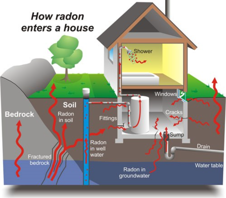 |
Radon can come out of the soil and seep into cracks, openings and gaps in your home. This is especially true on lower floors, basements or crawl spaces. All homes contain some level of radon. Levels will vary from one house to another, even right next door. The only way to be sure of the radon level in your home is to test. |
Testing for radon is easy. There are two ways to test a home for radon:
- Use a Health Canada approved do-it-yourself radon test kit
- Available for purchase at most hardware stores
- Borrow a radon monitor from a local library (where available - see below)
- Hire a certified, radon-measurement professional.
Radon levels can vary by day and week and month, so it’s important to measure radon for at least three months (91 days). It is recommended to test between October to April.
Some local public libraries lend radon monitors. These are different from radon test kits, and can be used as a first step to determine if you should complete a full radon test. The Haliburton County Public Library, Kawartha Lakes Public Library, Peterborough Public Library, and the Trent Hills Public Library (Campbellford) have radon monitors available for residents to borrow.
Understanding Your Test Results
Health Canada recommends indoor air radon levels be below 200 becquerels per cubic metre (200 Bq/m3). If a long-term (3-6 months) radon detection test determines your home to be above that level, consult a certified radon professional (1-855-722-6777). Levels above 600 Bq/m3 should be remediated within one year; levels between 200 and 600 Bq/m3 should be remediated within two years.
In Ontario, newly built homes have a 7-year warranty for radon remediation. If levels are above the guidelines set by Health Canada (200Bg/m3), this warranty should cover remediation costs.
What is Radon?
Radon is an invisible radioactive gas that comes from the ground and is in every home in Canada. It’s the #1 cause of lung cancer in non-smokers. You can't smell, taste or see radon. But it's easy to test for and easy to reduce to safe levels.
- A Homeowner’s Guide to Radon – Canadian Real Estate Association
- Resources for Homeowners – Take Action on Radon
- For Homeowners – Canadian Association of Radon Scientists and Technologists
- Radon – Canadian Cancer Society (Factsheet, 2016)
- Reducing Radon – Canadian Partnership For Children’s Health and Environment
- Radon – CARex (Carcinogen Exposures) Canada
- Radon – Health Canada
- Evict Radon: Action, Empowerment, and Education
- Naturally-Occurring Elevated Radon – Port Hope Area Initiative
If you are a Health Professional looking for resources click here.
Contact Our Team
We’re here to help. Reach out and we’ll respond as quickly as possible.